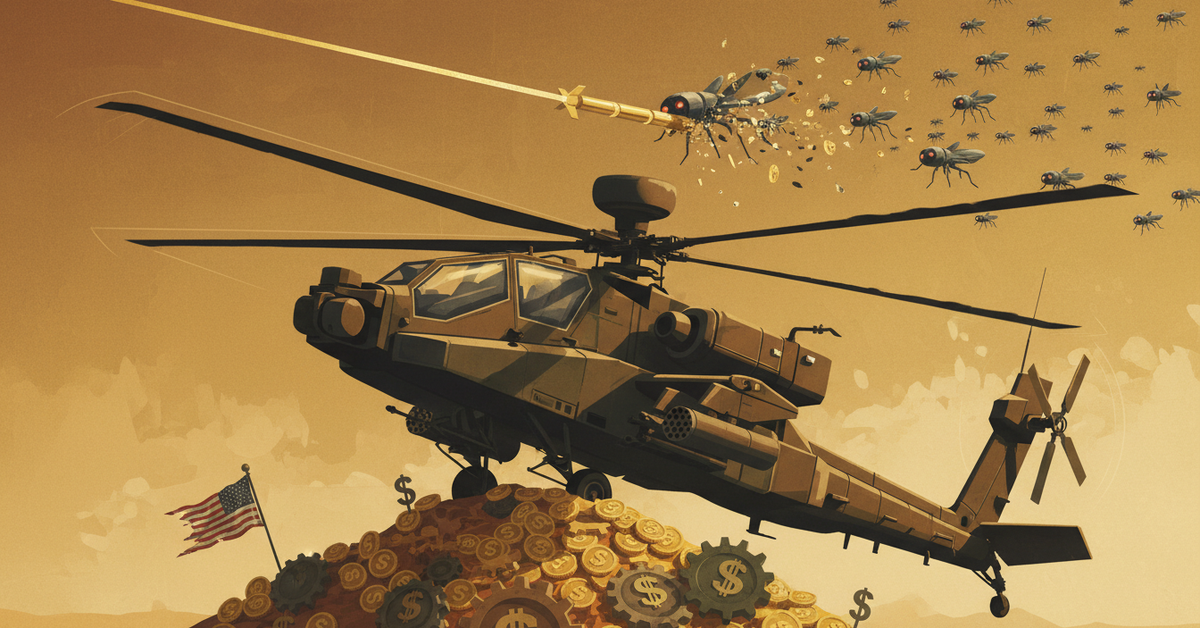
The world’s deadliest attack helicopter is learning to hunt gnats. In exercises over American deserts, the AH-64E Apache, a machine costing up to $40m and built to destroy columns of Soviet tanks, is now firing special ammunition to down tiny drones that can be built for $300. This is not a sign of versatility. It is a symptom of a deep doctrinal crisis confronting the Pentagon, where its most expensive assets face a chaotic reckoning with the cheap, disposable tools of modern war.
The problem is a ruinous asymmetry of cost. An explosive-laden drone, adapted from a commercial model, forces a duel with a weapons platform that represents decades of research and billions in investment. Every engagement pits a highly trained, two-person aircrew and its vast logistical tail against an opponent that costs less than a television. An adversary can afford to lose thousands of such drones. The U.S. Army cannot afford to win such battles indefinitely. The exchange ratio is unsustainable.
Technically, the Apache can perform its new job. In a November 2025 exercise, an AH-64E destroyed 13 of 14 drone targets using newly developed XM1225 APEX 30mm proximity-fuzed rounds. But this tactical success masks a profound strategic retreat. The Apache was conceived as an apex predator, a tool for striking deep into enemy territory to eliminate high-value targets. It is now being re-tasked as a defensive screen for ground units against a low-tech threat that can swarm from any direction. Its mission is shifting from hunting to swatting. This is a degradation of purpose for a crown-jewel asset.
The army’s leadership is scrambling to adapt. General Randy George, the chief of staff, has declared that drones are “changing everything” about combined arms combat. Yet formal doctrine is lagging far behind battlefield reality. Field Manual 3-04, the army’s aviation bible, received a minor update for unmanned systems in March 2025, but a full intellectual overhaul is not yet in sight. In its place are ad-hoc initiatives. The army held its first “Best Drone Warfighter Competition” in early 2026 and has established “Project Victor,” an AI-powered database to absorb battlefield lessons. These are the frantic actions of an institution that knows it is behind.
Field Manual 3-04, the army’s aviation bible, received a minor update for unmanned systems in March 2025, but a full intellectual overhaul is not yet in sight.
Blue UAS Program Evolution & Procurement Speed
Number of Systems
Procurement is being upended, too. The Pentagon’s Blue UAS Select list, which vets commercial drones for military use, is expanding rapidly. The goal is to slash acquisition times for new systems, a stunning admission that the Pentagon’s decades-old process of developing bespoke hardware cannot compete with the speed of the commercial market. The system that produced the Apache is too slow and too expensive to produce the weapons needed to defeat its new, cheaper adversaries.
The Army's helicopter pilots are not alone in their predicament. In the Red Sea, the Navy has expended missiles costing millions to destroy rudimentary Houthi drones. Air Force planners, meanwhile, quietly question how a stealth fighter like the F-35, the most expensive weapons system in history, would fare against a swarm of thousands of autonomous drones. The problem is not confined to a single service. It is a systemic vulnerability in the American way of war, which has for 50 years equated technological sophistication with battlefield dominance.
A bitter irony underlies this new reality. America is scrambling to counter a threat built, in large part, by its chief strategic rival. China dominates the global manufacturing of commercial drones and their components. The very supply chains that power American consumer life are providing the raw materials for the weapons now threatening its military. Washington is effectively reliant on its adversary's industrial base to field the cheap systems it needs to practice against, and which its own enemies can easily acquire.
To be sure, some argue this is adaptation, not crisis. The Apache, they contend, is a multi-role platform; adding counter-drone capabilities simply increases its utility for the modern battlefield. General George’s decision to reject a separate “Drone Corps” and instead integrate unmanned systems into every unit is seen as a prudent evolution, avoiding new institutional silos. This view, however, mistakes tactical capability for strategic solvency. No amount of successful tests can alter the ruinous economics of firing exquisitely engineered munitions at mass-produced electronics.
For half a century, American military power has been built on a small number of technologically superior platforms, each costing billions. That model is now being challenged by a numerous and cheap threat that attacks the economic foundation of that superiority. It is an assault not just on an army’s assets in the field, but on the Pentagon’s entire business model of procurement and war-fighting. The result is a force that is exquisitely prepared for a conflict it may no longer be able to afford.
The apex predator of the 20th-century battlefield is being stalked by its own balance sheet.