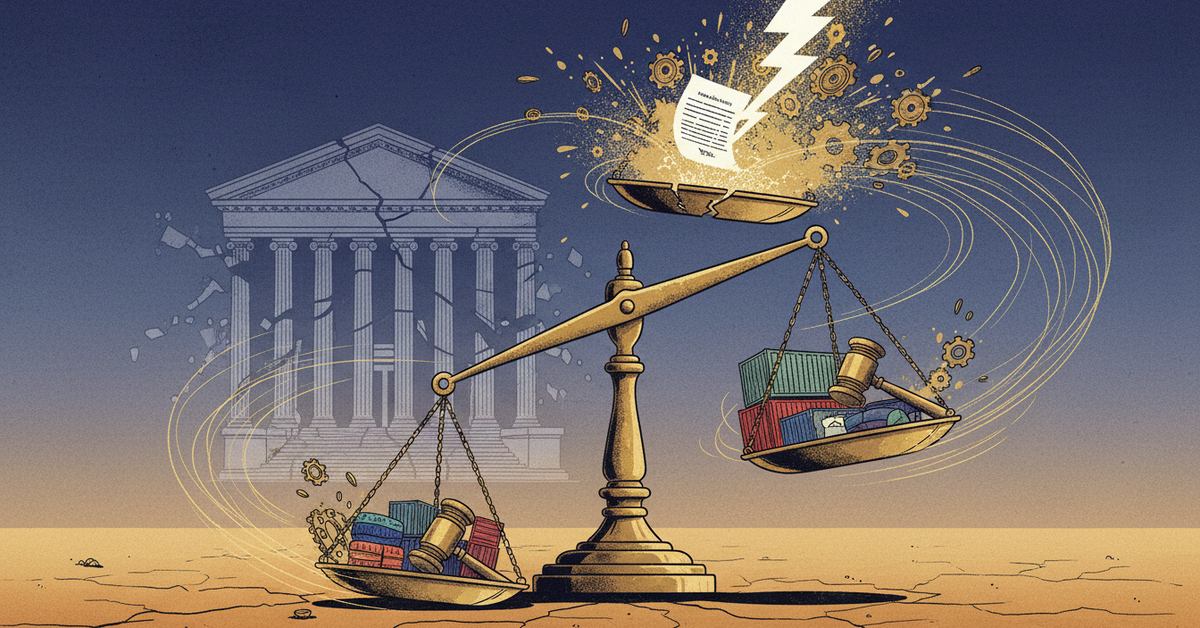
A definitive legal victory can be worse than a defeat. For America’s fashion and retail industries, the Supreme Court’s decision on February 20th to strike down a raft of tariffs should have been a moment of triumph. Instead, by provoking an immediate and punitive response from the White House, it revealed that the rule of law is no longer a reliable buffer against political impulse in American trade policy. The courts have spoken. It hardly matters.
The 6-3 ruling invalidated the so-called ‘Liberation Day’ tariffs, which had been imposed under the International Emergency Economic Powers Act (IEEPA). The court affirmed a foundational principle: the power to levy duties belongs to Congress, not the president. Industry associations, which had fought the tariffs for years, released jubilant statements celebrating a win for constitutional order. That optimism lasted mere hours. Before the ink on the court’s opinion was dry, President Donald Trump announced a new, global 15% tariff on a wide range of goods, effective February 24th. The whiplash stunned businesses. A clear legal win had provided no relief.
This time, the legal justification was Section 122 of the Trade Act of 1974. The choice was telling. The provision was designed to grant presidents a temporary tool to combat “serious balance-of-payments deficits”—a relic of the collapsing Bretton Woods system. America faces no such deficit today. Its use is a legal stretch, signalling that any obscure authority is fair game. The executive had simply pulled a different lever to achieve the same end.
The financial consequences are immense. The Supreme Court’s decision created a potential liability for the Treasury of over $160 billion in unlawfully collected IEEPA duties. For companies forced to absorb these costs, a refund was a lifeline. It was an illusion. President Trump has vowed to tie up the reimbursement process in litigation for years, ensuring the government keeps the cash. The victory is notional; the costs are real.
Their choices are to absorb the costs, crushing margins; pass them on to consumers, risking sales; or fold.
Tariff Whiplash: A Timeline of Instability
Average Tariff Rate (%)
Estimated Tariff Impact by Industry
Average Tariff Rate (%)
Such executive improvisation makes long-term planning impossible. By October 2025 the average tariff on apparel imported into America had soared to 26.4%, up from 14.7% just nine months earlier. In response, large firms began hugely expensive adjustments. After its shares fell 14% following an earlier tariff announcement, Nike started a painful reorganisation of its manufacturing. The goal was to slash its reliance on China and mitigate a projected annual tariff bill of over $1 billion. Such strategic shifts take years and vast capital. The administration’s latest move renders them a gamble.
Nike's scale affords it options, however costly. For the thousands of smaller apparel importers, the calculus is grimmer. They lack the capital to re-route global supply chains on a whim. Their choices are to absorb the costs, crushing margins; pass them on to consumers, risking sales; or fold. The instability creates a brutal sorting mechanism. It favours giants who can endure the shocks over the smaller firms that are the lifeblood of the industry.
The chaos is not contained within America's borders. Manufacturing hubs are taking note. In Vietnam, planners now see over-reliance on the American market as a critical vulnerability and will accelerate diversification to Europe and Asia. Rival consumer markets see an opportunity. European fashion houses can now offer more stable, predictable partnerships to global suppliers, potentially peeling away investment and talent that once defaulted to America.
To be sure, proponents of this approach within the White House see instability not as a bug, but as a feature. They argue that decades of predictable, rules-based trade allowed countries like China to exploit the system. In this view, strategic unpredictability is a necessary tool to keep adversaries off-balance and force concessions. The 150-day limit on Section 122 tariffs is not a weakness, but a tactical device—a “bridge,” as officials call it, to maintain negotiating pressure while a more permanent tariff structure is engineered. For them, corporate discomfort is a small price to pay for reclaiming national economic sovereignty.
But this strategy mistakes disruption for discipline. Political risk analysis has supplanted economic calculation in corporate boardrooms. For decades, sourcing decisions for fashion brands were a complex but legible exercise in balancing labour costs, quality, and logistics. Now, executives must become experts in constitutional law and political tea-leaf reading. They must plan for scenarios based not on market fundamentals, but on the shifting moods of the executive branch.
This sustained uncertainty is more damaging than any single tariff. It chills investment and stalls hiring. The brief celebration of a Supreme Court victory has given way to a grim realisation. The core problem was not one specific duty, but the weaponisation of trade policy itself. For an industry that operates on global supply chains and long lead times, this radical instability is poison. The most valuable commodity in global trade used to be the shipping container. Now, it is foresight—and it is nowhere to be found.