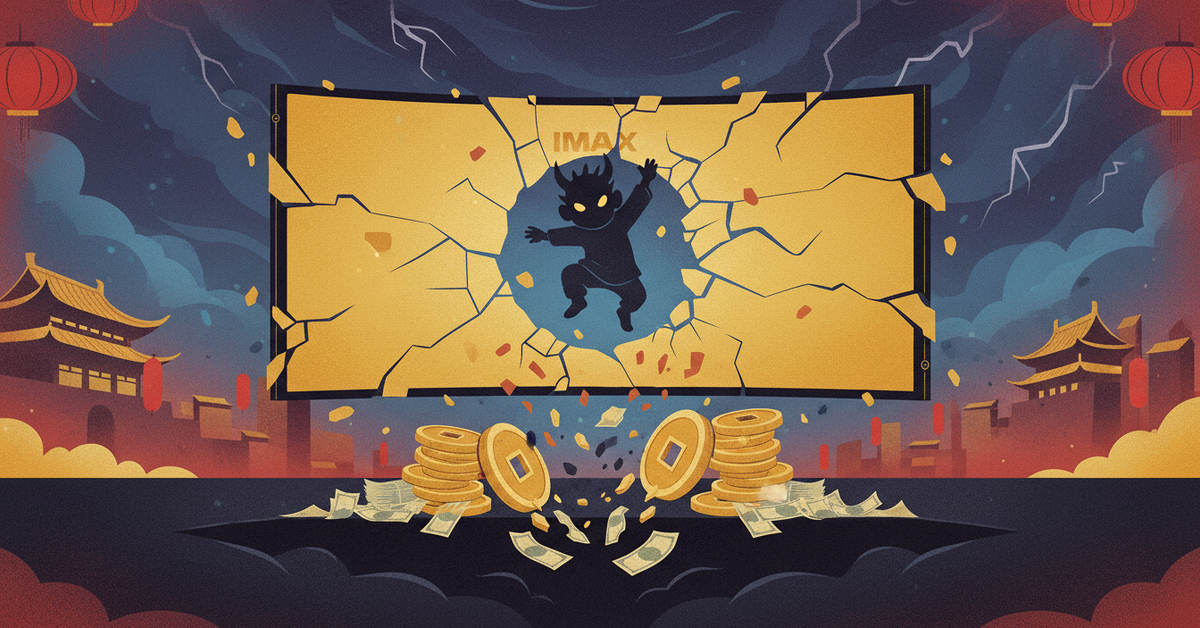
The absence of a single animated demon-child explains Imax’s holiday headache in China. The cinema giant’s box-office takings for a recent Chinese New Year period fell significantly, a steep drop from the record haul in 2025. Such a decline would normally send investors scrambling for the exits. The real story, however, is not one of waning appetite for giant screens, but of the immense gravitational pull of a true cultural blockbuster—and what happens when one fails to appear.
The year 2025 was an anomaly built on myth. The holiday period was dominated by “Ne Zha 2”, a mythological epic that became a national event. That film alone accounted for a substantial portion of the company’s entire holiday revenue in Imax theatres. The recent holiday slate, by contrast, had no such anchor. Its top performer was a popular racing franchise film that earned a respectable amount on Imax screens. By any normal measure, it is a commercial success, having already out-grossed its predecessors. But it is not a phenomenon.
The cultural and commercial force of films from Hollywood has been receding in China for some time, forcing Imax to tie its fortunes almost entirely to Chinese filmmaking.
This blockbuster deficit was felt across the industry. China’s total holiday ticket sales fell substantially from 2025. The number of moviegoers was also significantly lower. Against that bleak backdrop, Imax’s performance looks less like a collapse and more like a reversion to the mean. Its revenue fell, but its grip on the premium market held firm. The company’s share of a much smaller pie barely budged from the level seen in 2025.
Imax China CNY Box Office: 2025 vs. 2026
$ millions
Top Imax Film Performance: 'Ne Zha 2' (2025) vs. 'Pegasus 3' (2026)
$ millions
This dependence on local hits is the new reality for Imax in its second-largest market. For years, the company’s China strategy was straightforward: provide the best possible screen for Hollywood’s biggest exports. That model has broken. The cultural and commercial force of films from Hollywood has been receding in China for some time, forcing Imax to tie its fortunes almost entirely to Chinese filmmaking. This pivot has allowed the company to benefit from the rising quality and ambition of Chinese filmmaking. It has also made Imax’s quarterly earnings far more volatile, yoking them to the unpredictable rhythm of local production schedules.
The result is a feast-or-famine business cycle. A year with a generational hit like “Ne Zha 2” can deliver record-breaking profits and flatter the company’s global balance sheet. A year with a merely solid slate, as seen recently, produces headlines about a significant revenue drop. For Imax and its shareholders, this is the price of admission to the world’s largest film market. The steady, predictable stream of sequels from Hollywood has been replaced by the less frequent, but often more potent, eruption of a homegrown Chinese cultural event.
To be sure, such volatility exposes a genuine vulnerability. Relying on a handful of local tent-pole films each year is a risky strategy. A competitor, the state-backed China Film Giant Screen (CGS), is expanding its network and offers a cheaper, if less prestigious, alternative. During a holiday season with a thin slate, the premium price for an Imax ticket becomes harder for consumers to justify. If China Film Giant Screen (CGS) can position itself as the sensible choice for films that are not must-see events, it could steadily erode Imax’s market share.
For now, however, Imax remains the premier destination for China’s biggest cinematic moments. Its challenge is that it has no control over when those moments arrive. For decades, the company brought Hollywood's vision to China. Now it must wait for China to provide its own.