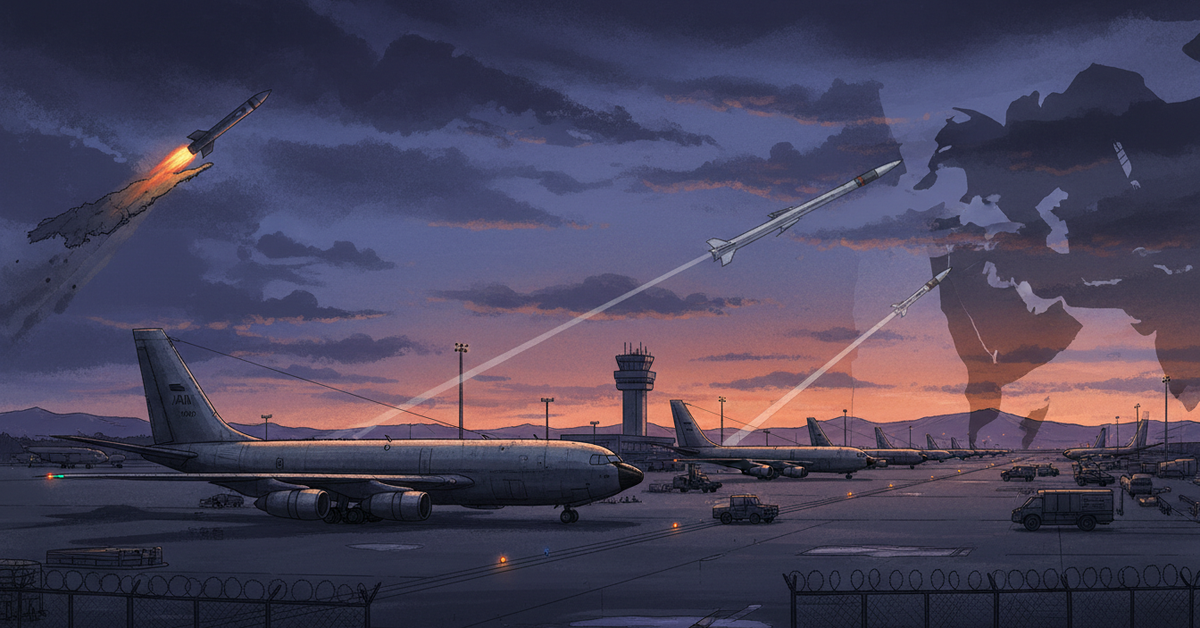
The road to a potential war with Iran now runs through a civilian airport in Sofia. Since last week, Bulgaria’s main international gateway has been closed to commercial traffic. Its aprons are crowded not with holidaymakers’ jets but with American KC-135 Stratotankers. These aerial refuelling aircraft, essential for long-range bombing missions, are the most visible part of a buildup that reveals America’s grim new strategic reality. As negotiators prepare for last-ditch nuclear talks with Iran on February 26th, the Pentagon is confronting a second nuclear crisis, one stretching from Moscow to Pyongyang.
The deployment in Bulgaria is the logistical hub for the largest concentration of American military power in the Middle East since the 2003 invasion of Iraq. The hardware tells the story. The tankers, operating under a 2006 defence agreement, enable fighter squadrons based in Europe to strike deep into Iran and return without landing in the immediate conflict zone. They support a formidable force. Two American aircraft carrier strike groups are on station, at a combined operating cost of over $18m per day. More than 120 Air Force jets, including stealth fighters, have been moved within range. For Israel and Saudi Arabia, long haunted by the prospect of a nuclear Iran, the American muscle is a welcome, if nerve-wracking, sight.
This show of force is aimed at Tehran. Talks in 2025 collapsed, leading to a series of Israeli and American strikes on Iranian facilities which, intelligence agencies assess, did not permanently cripple the programme. Before those strikes, Iran had a significant stockpile of uranium enriched to 60% purity, a short step from the 90% needed for a weapon. Its breakout time—the period needed to produce enough fissile material for one bomb—was measured in weeks. The White House has made clear that if the new talks fail to secure a verifiable rollback, military action remains on the table. The hardware parked in Sofia is designed to make that threat credible.
Half a continent away, a graver threat is solidifying. Russia’s war in Ukraine has made it dependent on North Korea. Pyongyang has shipped millions of artillery shells and advanced ballistic missiles to the Russian front. In an unprecedented move, it has also deployed thousands of its own soldiers to fight for the Kremlin. This support has been crucial for Russia’s war effort. It comes at a terrifying price.
South Korea, which in February 2026 unveiled a new anti-submarine drone boat, is now openly pursuing its own nuclear-powered attack submarines with American approval.
In exchange for munitions and manpower, Vladimir Putin appears to be providing Kim Jong Un with Russia’s most sensitive military secrets. Intelligence reports suggest Moscow has supplied Pyongyang with technology for nuclear-powered submarines, possibly including entire propulsion modules from decommissioned vessels. Such a transfer would be one of the most significant acts of nuclear proliferation in a generation. It would grant North Korea a survivable, sea-based second-strike capability, rendering regional missile-defence systems far less effective. The non-proliferation regime, already battered, would be broken.
U.S. Military Posture: Middle East & Black Sea
$ billions
The fallout from Pyongyang’s new power is landing first in Seoul and Tokyo. South Korea, which in February 2026 unveiled a new anti-submarine drone boat, is now openly pursuing its own nuclear-powered attack submarines with American approval. Its defence budget is projected to hit $54.7 bn by 2029. Japan has condemned North Korea’s actions as a “grave threat” and is pushing its own defence budget to record levels. Both countries are intensifying joint anti-submarine drills with America, such as those held in April 2023. An arms race is accelerating.
America can no longer treat Iran’s nuclear ambitions and North Korea’s arsenal as separate problems. The Kremlin’s actions have fused them. By arming a rogue state with top-tier nuclear technology, Russia has raised the stakes for every potential proliferator, including Iran. It has shown that the old rules, enforced by bodies like the UN Security Council, are defunct. America is therefore being forced to contain two sophisticated nuclear threats at once, a task stretching its military, its budget and its diplomatic capacity. The Pentagon’s requested budget for 2025 was nearly $850 bn, part of a national defence bill that now exceeds $900 bn.
For the world’s other superpower, this is a welcome crisis. China benefits from an America distracted by conflicts in Europe and the Middle East, burning through diplomatic capital and expensive munitions. Yet Beijing’s satisfaction is surely tempered by anxiety. A nuclear-armed North Korea on its border, newly emboldened by Russian technology, is a source of profound instability. A nuclear Iran would threaten the Middle Eastern energy supplies upon which China’s economy depends. Beijing may find that a world where American-led rules collapse is more dangerous for its own interests than it had imagined.
To be sure, some strategists in Washington view these as distinct challenges. They argue that Russia, even in its desperation, would be loath to share its submarine “crown jewels” with an unpredictable partner. They see the American buildup in the Middle East as classic coercive diplomacy—a credible bluff designed by the White House to force concessions from Tehran, not a prelude to an inevitable war. This view holds that the two situations can be de-escalated independently.
Yet this compartmentalised analysis feels dated. Moscow’s reliance on Pyongyang’s arsenal is now so profound that previously unthinkable technology transfers have become plausible. In the Persian Gulf, after the limited strikes of 2025 failed to halt Iran’s programme, the line between a diplomatic threat and a military commitment has grown dangerously thin. The crises are feeding each other. They create a single challenge to a world order built on preventing the spread of nuclear arms. This new reality demands sustained investment in advanced aircraft, anti-submarine warfare and missile defences.
Defence budgets are already rising across NATO and in allied Asian countries. Military procurement is shifting towards high-end capabilities designed to deter nuclear-armed states. The quiet transformation of a Bulgarian airport into a forward base for a potential air war is a case in point. It is a costly, overt and risky move. It is also seen as necessary. The era of managing proliferation through sanctions and treaties is over.
The old non-proliferation regime was built on inspections and international consensus. Its successor may be defined by the serial numbers on a Russian submarine reactor sold to Pyongyang.