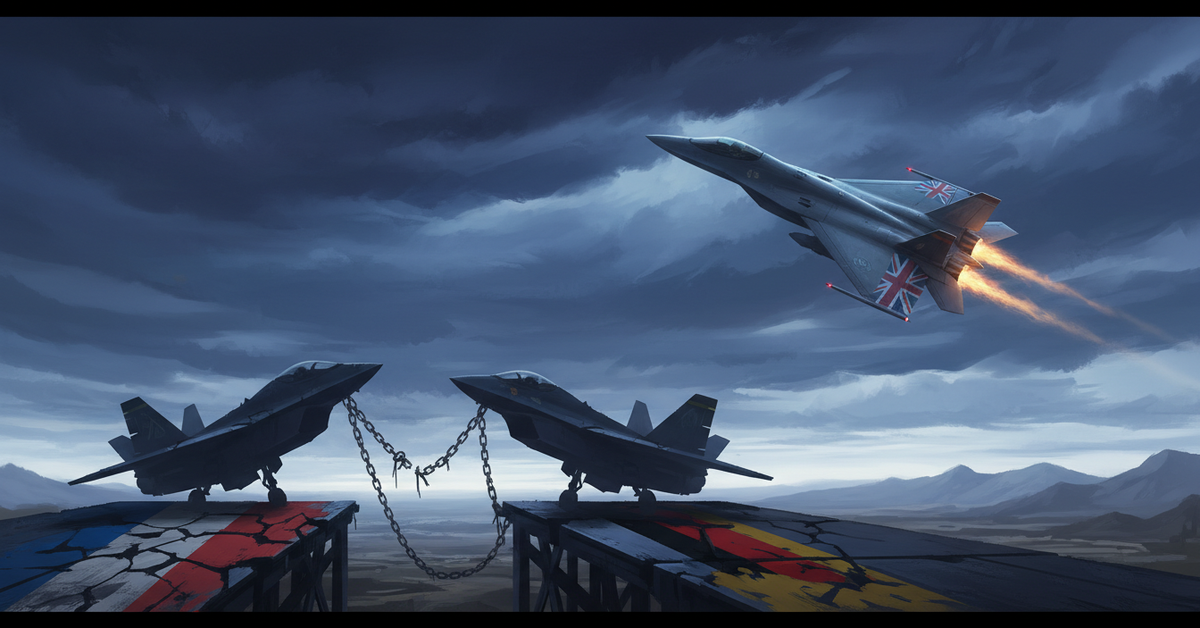
“A French-German-Spanish sixth-generation fighter jet will not be coming.” So declared Theo Francken, Belgium’s defence minister, on February 20th. His blunt obituary for the Future Combat Air System (FCAS), Europe’s most ambitious defence project, was not hyperbole. The €100 billion programme is grounded by a fundamental disagreement over what a modern warplane is for. This Franco-German strategic rift has not only stalled the continent’s flagship military effort but cleared the skies for a competitor.
At the heart of both FCAS and its rival, the Global Combat Air Programme (GCAP), is a desire to avoid future dependence on American hardware. The F-35 is the dominant fifth-generation aircraft, the benchmark against which all successors are measured. For Europe, designing its own replacement is a matter of industrial and strategic survival. Yet FCAS is foundering on the irreconcilable doctrines of its two main backers.
France, a nuclear power with an independent foreign policy, requires an aircraft that can operate from an aircraft carrier and deliver its nuclear deterrent. Germany, a continental power deeply embedded in NATO’s command structure, needs an air-superiority fighter optimised for European skies, with no nuclear role. Forcing these clashing requirements into a single airframe has proved impossible. The industrial rivalry between France’s Dassault, the designated project lead, and Airbus, representing German and Spanish interests, is merely a symptom of this deeper strategic divergence. The impasse is so severe that Airbus has floated a desperate “two-fighter solution”. Dassault has ignored it.
In contrast, GCAP—a venture between Britain, Italy and Japan—is a functioning example of “Global Britain”, a post-Brexit strategy focused on building flexible alliances with partners in the Indo-Pacific and beyond.
This is more than a procurement dispute; it is a clash of geopolitical visions. FCAS was meant to be a pillar of the EU’s quest for “strategic autonomy”, a tangible symbol of a Europe that could defend itself. But its paralysis reveals the limits of that ambition. In contrast, GCAP—a venture between Britain, Italy and Japan—is a functioning example of “Global Britain”, a post-Brexit strategy focused on building flexible alliances with partners in the Indo-Pacific and beyond. One project is an expression of an ideal, the other a product of pragmatism.
To be sure, the political capital sunk into FCAS is immense. A last-minute deal between Paris and Berlin to salvage some parts of the “system of systems”, such as its combat cloud or unmanned drones, cannot be ruled out. Proponents argue that the project’s scale makes it too big to fail. But this mistakes activity for achievement. The heart of any combat air system is the fighter jet itself. On that front, FCAS has lost its momentum and its credibility.
While FCAS has been mired in power struggles, GCAP is progressing. It is on track for a 2035 service entry date, five years ahead of the FCAS target. Its greatest asset is its governance. Instead of a fraught relationship between a designated leader and junior partners, GCAP is a joint venture with equal 33.3% stakes for its lead industrial firms. This has averted the leadership disputes that poisoned the Franco-German effort. The model’s stability is attracting interest. Saudi Arabia is in discussions to join, an idea to which Britain and Italy are receptive.
The paralysis in Paris and Berlin is felt most acutely in Madrid. Spain, the third FCAS partner, is openly frustrated by the stalemate. Should the project collapse, it is a prime candidate to defect to GCAP. Madrid’s position is complicated by its navy’s need to replace its Harrier jets, which are due for retirement by 2030. The American F-35B is the only available aircraft that can operate from its ships. This creates a powerful pull towards American hardware, even as Spain’s air force officially waits for a European solution that may never arrive.
The contrast is stark. BAE Systems, Britain’s industrial lead on GCAP, expects its Eurofighter production lines to remain busy until work begins on the new jet, ensuring a seamless transfer of skills. For FCAS, there is only stasis. Europe will get a sixth-generation fighter. It just will not be the one its two biggest powers tried to build together.