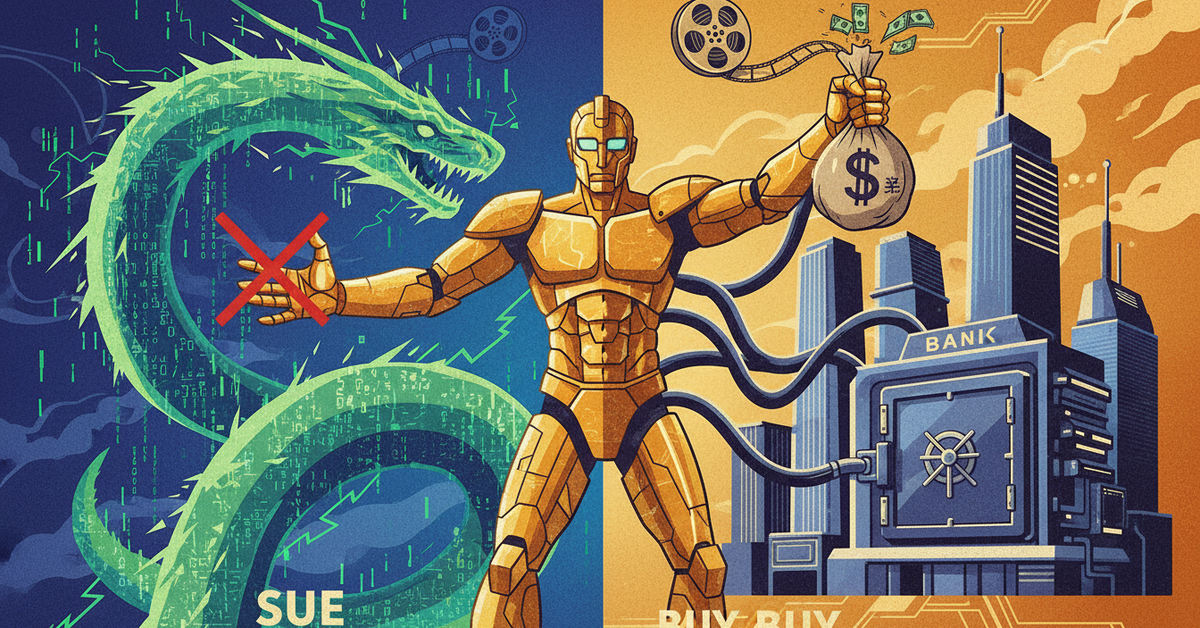
Hollywood’s strategy for artificial intelligence is to sue it and to buy it. In early 2026 Netflix branded a new video-generation tool from ByteDance, a Chinese tech firm, a “high-speed piracy engine”. Along with Disney and Paramount, it sent cease-and-desist letters, alleging the model, Seedance 2.0, was illegally trained on its copyrighted films. Yet just two months earlier, in December 2025, Disney had ploughed $1 billion into OpenAI and licensed its characters for use on the platform. This is not hypocrisy. It is a calculated, two-front war for control, waged by an industry under immense pressure from Wall Street to make its streaming empires profitable.
The fragile peace that this strategy shattered was less than three years old. The 2023 guild truce, which ended the longest joint strike in Hollywood history, was built for an obsolete technological world. The Writers Guild of America, on strike from May 2nd to September 27th, won a clause stating that AI cannot be a “writer”. The actors’ union, SAG-AFTRA, which picketed from July 14th until a deal was ratified on December 5th, secured rules requiring consent and compensation for an actor’s “Digital Replica”. These safeguards were designed for the AI of 2023. They are being outflanked by models like OpenAI’s Sora and ByteDance’s Seedance, which generate high-fidelity video from a simple text prompt. They do not merely replicate an actor or rewrite a script; they can bypass them entirely.
The studios have therefore opened a contradictory campaign. The first front is legal. The letters to ByteDance are an opening salvo in a fight to define intellectual property for the AI era. The argument is that models which can conjure up characters from “Star Wars” without a licence are committing mass copyright infringement. By suing, the studios hope to establish their film libraries not as public inspiration, but as private, monetisable training data. The goal is to control the raw material for the next generation of content.
The AI, they claim, is not making a digital copy of a film but learning statistical patterns from tens of millions of images and texts.
Tech firms, naturally, disagree. Their defence rests on the American legal concept of “fair use”. Companies like OpenAI and ByteDance argue that scraping the public internet for data to train their models is transformative. The AI, they claim, is not making a digital copy of a film but learning statistical patterns from tens of millions of images and texts. This is akin to a human artist studying countless works to develop a style. The output is something new. The courts have yet to decide who is right, leaving the ownership of the digital imagination in legal limbo.
The second front is financial. While lawyers draft complaints against some AI firms, executives are signing deals with others. Disney’s billion-dollar stake in OpenAI is a move to secure influence at the heart of the AI boom. Lionsgate has partnered with Runway, another startup, to build custom AI models trained exclusively on its own film library. The aim is to create proprietary tools for everything from storyboarding to visual effects. If automated movie-making is inevitable, the studios intend to own the machinery.
Behind this dual strategy is a relentless search for efficiency. The streaming wars forced studios to produce an overwhelming volume of content to attract subscribers. Now, Wall Street demands that content be profitable. Generative AI promises a path to radically lower costs by compressing timelines and, most importantly, automating labour. For studios struggling to turn a profit on their streaming services, the allure of slashing budgets is powerful.
This automation is not a distant prospect. A 2024 study commissioned by the Animation Guild and other labour groups estimated that AI could disrupt over 200,000 entertainment jobs in America within three years. The roles most immediately threatened belong to the vast ranks of “below-the-line” artists and technicians. A concept artist who once spent weeks illustrating a key scene now finds their job is to refine text prompts for an AI to generate dozens of options in minutes. 3D modelers and sound editors see their intricate skills being replicated by algorithms. For the unions, this is an existential threat that the 2023 contracts cannot contain.
To be sure, the studios argue this is merely the next chapter in technological evolution. They contend that AI will function as a tool, augmenting artists rather than replacing them. Computer-generated imagery, they note, changed cinematography but did not eliminate the cinematographer. In this view, AI will free creators from tedious work to focus on higher-level decisions. Partnering with firms like OpenAI, they insist, is the only way to shape the technology’s development from the inside and ensure it serves storytelling.
But the disruption’s speed and scale are without precedent. Previous technologies automated specific parts of the filmmaking process. Generative AI targets the core of creative work itself. And while Hollywood’s problems are acute, they are not unique; similar battles over AI’s role in culture are brewing in Europe and India. The risk is not just the displacement of jobs, but the commodification of the creative spark. The industry’s frenemy strategy is a high-stakes wager that it can deconstruct the old Hollywood assembly line without destroying the value of what it produces. The legal battles are not just about preventing piracy. They are a fight to determine who controls the foundational models of an automated culture. The studios are not trying to stop the machines; they are trying to own the ghosts inside them.