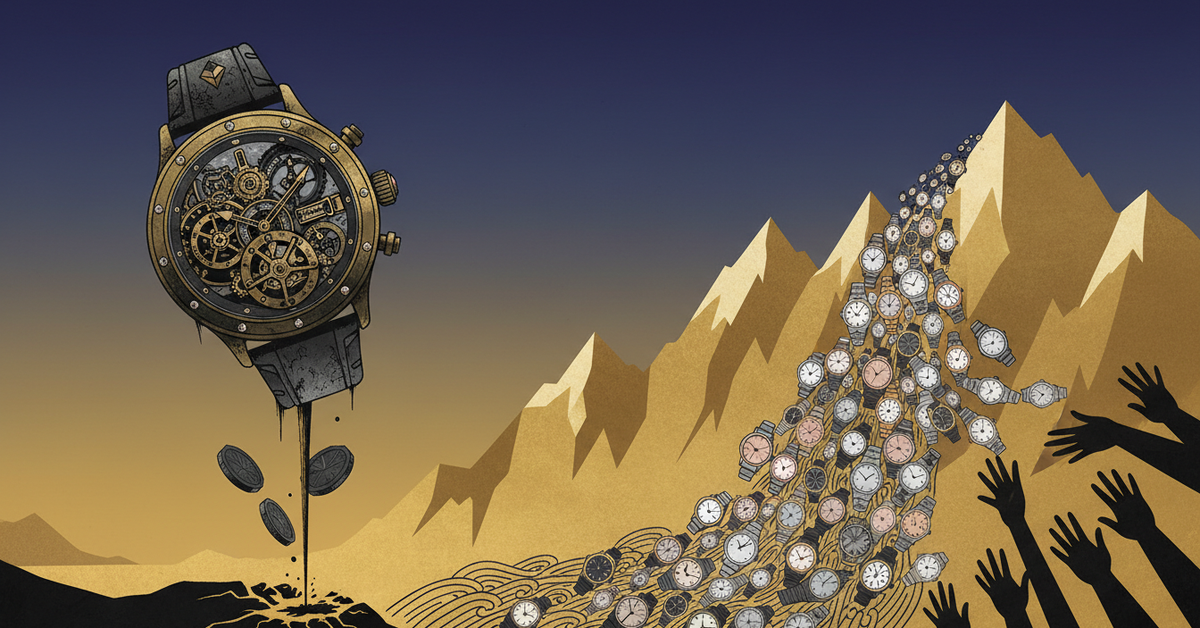
The world’s most expensive watches are becoming harder to sell. In January exports of Swiss timepieces priced above 3,000 francs fell by 8.1%. Meanwhile, shipments of watches in the more accessible 500-to-3,000-franc bracket jumped by 17.7%. This is more than a problem for watchmakers in the Jura mountains. It is a signal from a luxury market fracturing under the weight of its own recent success.
The post-pandemic spending spree is over. After years of aggressive price increases and record profits, luxury houses confront a divided customer base. The market for personal luxury goods reached €362 billion in 2023, but its growth slowed to just 4% at current exchange rates. The very wealthiest continue to buy, but the crucial aspirational shopper—the lawyer buying her first brand-name handbag, the tech worker saving for a statement coat—is pulling back. Squeezed by inflation and disillusioned by price tags detached from tangible value, this cohort is shrinking. According to Bain & Company, a consultancy, the global pool of these customers fell from 400m in 2022 to 340m by the end of 2025. The industry’s growth engine has stalled.
In response, the smartest brands are abandoning the traditional pyramid model, where entry-level items entice shoppers to climb towards the peak. They are instead adopting a “barbell” strategy. At one end, they are reinforcing extreme exclusivity for their top-tier clients. At the other, they are recalibrating their entry-level offerings to offer credible value. The middle is being hollowed out. Success in 2026, a year when the market is forecast to return to modest 3-5% growth, will depend on mastering this polarisation.
This means creating products whose value is legible only to other insiders, such as handbags made from exotic leathers treated with experimental techniques or watches with obscure complications.
Serving the top 1% is about more than just adding another zero to the price. It involves building a cultural moat. This means creating products whose value is legible only to other insiders, such as handbags made from exotic leathers treated with experimental techniques or watches with obscure complications. It also means shifting the experience from retail to relationship, with private appointments, bespoke commissions and client-only events that transform a purchase into an initiation. The goal is to create a form of exclusivity so complete that it cannot be easily bought, only entered.
Luxury Market Bifurcation: High-End vs. Aspirational Growth
Growth (%)
Moncler Group shows how this barbell strategy works in practice. The Italian firm, known for its glossy puffer jackets, saw revenues rise 7% in the final quarter of 2025, a strong performance in a cooling market. Its results reveal a company adept at playing both ends against the middle. The core Moncler brand, with its four-figure price tags, performed well among established clients in Asia and the Americas, where sales grew 11% and 9% respectively. Yet the real surprise was Stone Island, a more streetwear-inflected brand acquired in 2021. Its revenues surged by 16%, capturing a younger, aspirational consumer who might never enter a Moncler flagship store.
Legacy houses are pursuing a similar strategy within their own monolithic brands. Having led the charge on price hikes for its leather goods, Chanel is now carefully cultivating its more accessible offerings. Its “Chance” fragrance collection and “No. 1 de Chanel” beauty line are aimed squarely at Gen Z shoppers. These products, often priced below $200, provide an affordable entry point into the Chanel universe. This is no sideline. This approach was already proving its worth back in 2022, when such accessible lines helped Chanel's revenues grow by 17% to $17.22 billion.
To be sure, selling perfume and sunglasses is hardly a new trick for luxury houses. But the recent, sharp divergence in the market has changed the logic. The aggressive price increases of 2021-23 were a gamble that brands could elevate themselves into a stratosphere of pure exclusivity, shedding their more democratic customers along the way. That gamble has backfired. It alienated a vast customer base just as economic headwinds began to bite. Now, with even the top end of the market showing signs of weakness—witness the 14% drop in Swiss watch exports to the crucial American market in January—ignoring the aspirational buyer is a liability.
The brands that thrive will be those that can speak to two different customers at once, without allowing the accessible to devalue the exclusive. This requires a delicate balance of marketing, product design and distribution. Firms must create entry-level products that feel authentic, not like cheapened afterthoughts. They must manage the tension between the mass-market appeal needed to sell a lipstick and the scarcity required to sell a crocodile-skin bag. It is the hardest trick in the business.
This new reality poses a difficult question for the industry’s leaders. What is a luxury brand when its fastest-growing products are not its most exquisite? The answer is being decided not in the ateliers of Paris or the boardrooms of Milan, but by the calculations of millions of consumers. That 17.7% surge in mid-priced Swiss watches is more than a statistic. It is a verdict. The industry's future is being secured by the very customers it recently tried to leave behind.