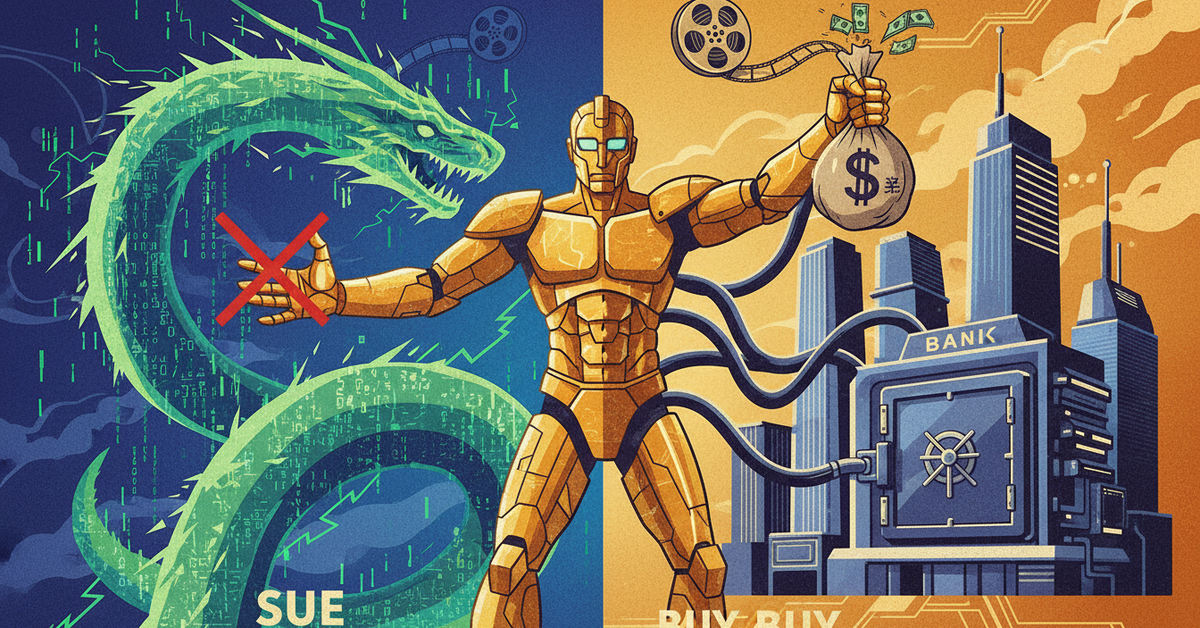
Spending 90 cents of every dollar on marketing is not a sign of a media company in crisis. It is the business plan. For the burgeoning microdrama industry, this seemingly ruinous strategy reveals a model that has little in common with Hollywood and everything in common with mobile gaming. The story is not the product. It is the bait.
This business model could not have existed five years ago. Its foundations were laid by two recent shifts. First, TikTok trained a global audience to consume narratives in vertical, one-minute bursts. Second, performance-marketing algorithms on social-media platforms became ruthlessly efficient. This created the perfect conditions for a new kind of entertainment: content cheap enough to be disposable, distributed by a system smart enough to find exactly who would pay for the next episode.
The economics are startling. An entire 80-episode series, shot for a smartphone screen, can be produced in the United States for between $100,000 and $300,000. In China, the cost can be as low as $27,000. This transforms content from a high-stakes asset into a low-cost tool for luring a user into an app. Viewers watch a few episodes for free until a cliffhanger—a spurned heiress, a secret billionaire, a mistaken identity—prompts them to buy digital coins to continue. The goal is to convert a viewer into a repeat purchaser, one impulse at a time.
It hinges on a brutal calculation borrowed from the world of mobile gaming: a user’s lifetime value (LTV) must exceed the cost to acquire them (CAC).
This model is powering explosive growth. In the first quarter of 2025, an app named ReelShort generated $130m from in-app purchases. Its rival, DramaBox, was close behind at $120m. Their true competition is not Netflix or Disney+, which fight for monthly subscription fees. It is TikTok and YouTube Shorts, which fight for the same slivers of attention. Microdrama’s innovation was to build a direct monetisation engine atop that fleeting attention, something the social-media giants, reliant on advertising, have not managed.
Daily User Time: Microdrama vs. Streaming
$ millions
Success, however, is not guaranteed. It hinges on a brutal calculation borrowed from the world of mobile gaming: a user’s lifetime value (LTV) must exceed the cost to acquire them (CAC). For a business to be viable, the LTV:CAC ratio should be at least 3:1. The precise figures for microdrama apps are a closely guarded secret, but a clear divergence in performance is already visible. In 2024 DramaBox proved the model can work, posting a $10m net profit on $323m in revenue. ReelShort, despite generating higher revenues of around $400m, remained unprofitable, its bottom line consumed by the immense cost of finding new users.
The winners in this market will be decided by algorithms, not auteurs. That vast marketing budget is not simply thrown at social-media feeds. It fuels a sophisticated data-science operation that uses machine learning to relentlessly optimise ad campaigns. The system identifies user profiles, predicts their spending habits and targets them with specific clips from specific shows. The most valuable intellectual property is not the script about a werewolf doctor. It is the mathematical model that can find the next person willing to pay $1.99 to see him save a patient.
To be sure, the entire enterprise looks dangerously frothy. The content is a churn of formulaic tropes, which has already attracted the attention of regulators in China, where the government has cracked down on “low-brow” productions. The user experience can feel predatory. More damning is the user retention. Across the mobile-app industry, a staggering 77% of daily active users are lost within three days of installation. It is easy to imagine audiences tiring of the repetitive plots and aggressive payment prompts, leaving platforms with a mountain of acquisition costs they can never recoup.
But this churn is a core assumption of the model, not an unforeseen flaw. Microdrama platforms are not trying to build a loyal subscriber base. They are not selling relationships; they are engineering millions of fleeting, profitable transactions. The business is designed to extract value quickly from a vast, constantly replenished pool of users before they inevitably move on. That DramaBox has reached profitability suggests that, for the most efficient operators, the maths can work. The high marketing spend is simply the price of admission to a market of impulses.
Hollywood studios that see a new wave of rival storytellers are misreading their competition. They are not up against another production house. They are up against a data-driven machine that has concluded the most profitable story is the one its algorithm tells itself about how to find the next dollar.